The Importance of Double-Blind Peer Review
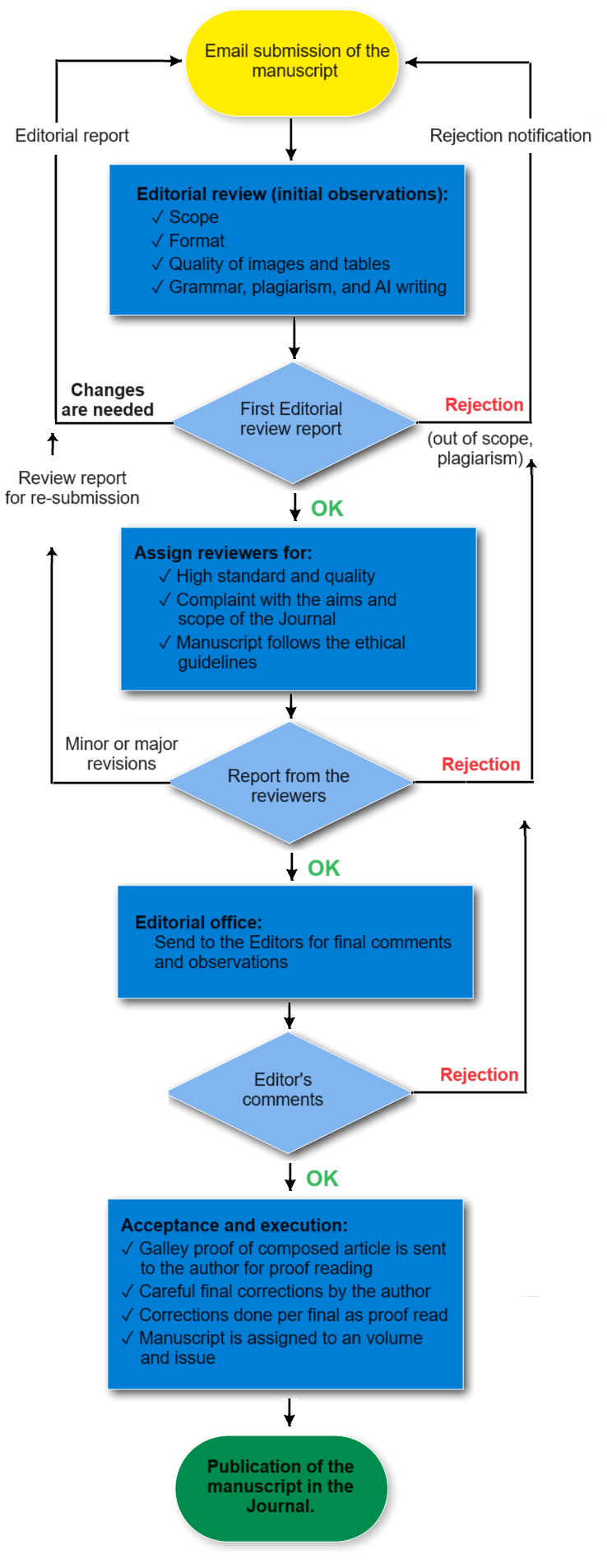
Double-blind peer review is a critical component of scholarly publishing. All submissions to Periódico Tchê Química are first assessed by an Editor to determine their suitability for peer review. Since reviewers volunteer their time, only manuscripts with strong publication potential are sent for review. Thus, the Editor filters out unsuitable submissions to avoid misuse of reviewers’ time. This initial screening may result in a request for improvements or outright rejection.
If any editorial team member is listed as an author or has a competing interest in a manuscript, another Editorial Board member will be assigned to oversee the peer review. Suitable submissions are sent to independent experts identified by the Editor. Author identities are removed from the manuscript file to ensure anonymity. The Editor makes the final decision based on reviewer reports, and authors receive a notification reflecting these reports and the editorial decision. Authors should note that even with a positive report, concerns raised by another reviewer may justify manuscript rejection.
Publication Criteria
To be accepted for publication in Periódico Tchê Química, a manuscript must meet the following criteria:
-
Originality: The study presents original scientific research and has not been previously published.
-
Methodological Rigor: Experiments, statistics, and analyses were conducted to a high technical standard and are described with sufficient detail for reproducibility.
-
Well-Supported Conclusions: Conclusions are appropriately stated and fully supported by the presented data.
-
Clarity of Writing: The manuscript is clearly written in standard English or Portuguese, following academic conventions.
-
Ethical Compliance: The research meets all applicable ethical standards for experimentation and research integrity, including ethics committee approval when required.
-
Data Availability: The article adheres to appropriate reporting guidelines and community standards for data availability.
-
Journal Scope: The work falls within the multidisciplinary scope of Periódico Tchê Química and contributes to the advancement of scientific knowledge.
Processing Times
Periódico Tchê Química is committed to an efficient review process. Typical processing times are:
Desk Review
7–10 days
Initial editorial assessment
Peer Review
60–90 days
External reviewer evaluation
Final Decision
up to 120 days
Expected total time
Note: These are typical timelines. Cases requiring additional evaluation or substantial revisions may take longer. If reviewer reports are conflicting or delayed, an additional expert opinion may be sought.
Possible Editorial Decisions
After peer review, the editor will issue one of the following decisions:
Accepted
The manuscript is accepted for publication without further revisions.
Minor Revisions
The manuscript will be accepted after minor corrections or clarifications, without further peer review.
Major Revisions
The manuscript requires substantial revisions and will be re-evaluated by reviewers after resubmission.
Rejected
The manuscript does not meet publication criteria and will not be reconsidered in this form.
Final Decisions
Final Report: A final decision to accept or reject the manuscript will be sent to the author, along with any recommendations from reviewers, which may include verbatim comments.
The Editor’s Decision is Final: Reviewers advise the editor, who is solely responsible for accepting or rejecting the article. The Editor’s decision is final.
Appeal Process
Authors who believe their manuscript was unfairly rejected may appeal the editorial decision. However, successful appeals are rare and occur only when there is clear evidence of error in the review process.
When to Appeal
An appeal may be considered if:
- A reviewer made substantial factual errors that materially affected the manuscript evaluation.
- There is clear evidence of bias by a reviewer that influenced the decision.
- Critical aspects of the manuscript were misinterpreted or inadequately considered.
- A significant procedural failure occurred during the review process.
When NOT to Appeal
An appeal will not be considered if based solely on:
- Disagreement with the reviewers’ scientific opinion.
- Desire to submit new data or arguments not included in the original manuscript.
- Simple dissatisfaction with the decision.
- Claim that the work is important without addressing the specific concerns raised.
How to Appeal
-
Deadline: Appeals must be submitted within 30 days of the rejection decision.
-
Documentation: Send a detailed letter to the Editor-in-Chief (journal.tq@gmail.com) explaining:
- Why you believe the decision was incorrect
- Specific evidence of error or bias
- How correcting this error would change the evaluation
-
Review: The Editor-in-Chief will assess the appeal, which may include:
- Consultation with other editorial board members
- Request for additional opinions from new reviewers
- Review of original reports and the manuscript
-
Decision: A final decision on the appeal will be communicated within 4–6 weeks. This decision is final and not subject to further appeal.
Important: Appeals are handled with lower priority than new submissions. Reversal of a rejection decision is rare and only occurs when the Editor-in-Chief is convinced a significant error was made. In most cases, authors are encouraged to consider the reviewers’ feedback and submit to a more appropriate journal or resubmit as a new manuscript after substantial revisions.
Artificial Intelligence Use Policy
Periódico Tchê Química has a detailed policy on the use of Artificial Intelligence tools in manuscript preparation. All authors and reviewers must consult our full Ethical Guidelines on AI.
Summary for Reviewers and Authors:
Acceptable AI Use:
- Grammar and spelling checks
- Clarity enhancement
- Assisted translation (with human review)
- Reference formatting
Prohibited AI Use:
- Generation of original scientific text
- Fabrication or manipulation of data
- Fabrication of references
- Manuscript analysis by reviewers
Research Misconduct and Ethics
Periódico Tchê Química follows COPE guidelines for handling suspected misconduct. For detailed ethical policies, please consult our full Ethical Guidelines.
Research Misconduct
All research involving humans (including human data and materials) and animals must have been conducted within an appropriate ethical framework. If there is suspicion that research was not conducted ethically, the Editor may reject the manuscript and may notify third parties, such as the author(s)’ institution(s) and ethics committee(s). In cases of proven misconduct involving published articles or when scientific integrity is significantly compromised, articles may be retracted.
Post-publication Discussions and Corrections: Complaints and appeals to the Editor-in-Chief via email (journal.tq@gmail.com) are available if authors have objections or disagreements regarding the publication process. Each complaint will be acknowledged and addressed to reach a fair resolution. Additionally, articles may be retracted for scientific or ethical reasons. The retracted article will be noted on the journal website, along with information about the reason for retraction.
Information for Reviewers
Peer reviews are essential to the editorial process and journal quality. A well-conducted review also helps guide authors in improving their work.
Reviewer Report Form
1. Conflicts of Interest
If you have any conflict of interest in reviewing this manuscript, please contact any of the journal’s Editors-in-Chief. The manuscript will be assigned to another reviewer. Conflicts may include:
- Personal conflict: A personal relationship with the author or institution that could interfere with providing an impartial evaluation.
- Financial conflict: Financial interest in a product, company, or organization discussed in the manuscript (e.g., stock ownership, consultancy).
- Intellectual conflict: Strong interest in seeing the manuscript published or not published.
2. Review Content
- Your review should focus solely on the manuscript’s content. Editing, grammar, punctuation, and formatting are the journal’s responsibility (we have an editorial team for this).
- Periódico Tchê Química is interested in manuscripts that reflect the 'state of the science' and, more importantly, include practical applications. Consider whether the content is accurate and up to date. Is there something the author omitted but should have included?
- Check cited sources. Are references appropriate, mostly recent (within 10 years), and from reliable sources? Is the material accurately represented or plagiarized? (Editors screen all submissions with plagiarism detection software before sending to reviewers, but if you notice anything, please indicate it.)
- If you recommend revision, provide detailed comments to guide the author. Specify what they should do to improve the manuscript. If you recommend rejection, your narrative should clearly explain why—but avoid spending unnecessary time on a manuscript with no publication potential.
3. Review Tone
Write your review without judgment. Begin with positive aspects, if possible. If you believe the manuscript should be revised, please be encouraging and specific in your comments. Avoid disparaging or unconstructive criticism.
4. Confidentiality
ATTENTION: All submitted comments are confidential and remain the property of PERIÓDICO TCHÊ QUÍMICA and may not be disclosed or published elsewhere. Manuscripts must be treated as confidential material. If you wish to consult a colleague, please contact an Editor-in-Chief beforehand. We recommend you keep a copy of your review for three months. All manuscripts are reviewed by at least two independent reviewers. Review forms will be sent to the author(s) anonymously.
Revised Manuscripts
Manuscripts returned to authors for revision must be resubmitted to the editors within three months. The revised manuscript should be sent to the same email address used in the original submission. Authors must also respond to reviewers’ comments, detailing changes made in the new version and justifying any suggestions they chose not to implement.
Final Version: Once all reviewer comments and revisions are resolved, editors will notify the author of acceptance or rejection via email. The Periódico Tchê Química editorial team reserves the right to make minor changes to the manuscript, if necessary, to align with journal style or improve clarity, while fully respecting the article’s content. Regardless of type, all manuscripts must be original in methodology, information, interpretation, or critique. Two reviewers will attest to the article’s quality.